Speak Before the Silence: What Fictional Last Messages Reveal About Our Fear of Vanishing Without a Trace
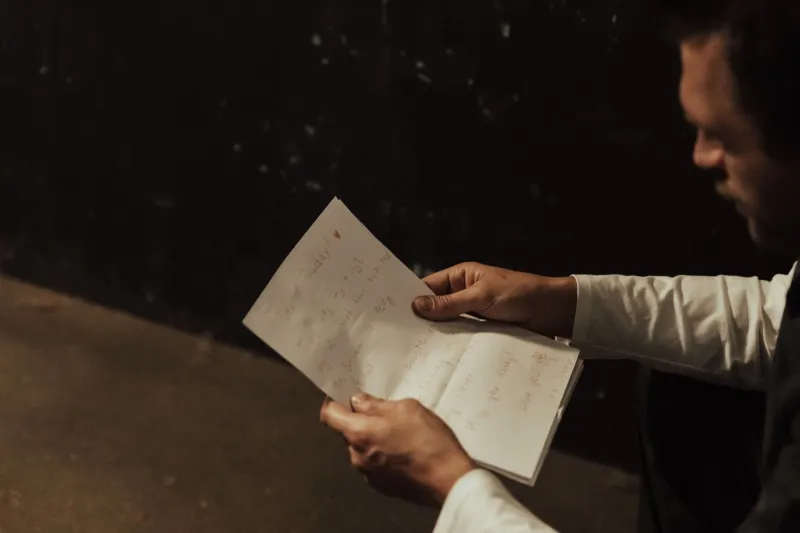
There is a recurring image embedded in the architecture of apocalyptic storytelling, one so familiar that audiences have largely ceased to notice how strange it truly is. The world is ending — through plague, through fire, through the slow mechanical failure of civilization itself — and yet the character before us is not running. They are writing. They are recording. They are speaking into the dark with the desperate, irrational conviction that someone, somewhere, will eventually listen.
This is the last transmission: the letter sealed in a tin box, the video diary uploaded to a dead server, the radio broadcast aimed at a sky that may no longer contain anyone capable of receiving it. As a narrative trope, it appears so frequently across American fiction that its prevalence demands examination. What, precisely, are we expressing when we imagine our final act not as survival, but as testimony?
The Compulsion to Leave a Record
In Cormac McCarthy's The Road, the father carries no written record of himself or his son. Their anonymity is part of what makes the novel so quietly devastating — two figures moving through ash with no names, leaving no document behind. McCarthy's choice feels almost radical precisely because it departs from the dominant convention. Most apocalyptic narratives cannot resist the pull of the final message.
Consider the Halo game franchise, which layers its world-building almost entirely through recovered audio logs and written testimonies from soldiers and scientists who did not survive. The player moves through ruins while the voices of the dead narrate their own extinction. The effect is not incidental. The designers understood that audiences experience the end of the world most acutely not through spectacle, but through the intimate weight of a single human voice trying to matter.
This instinct appears equally in literary fiction. Emily St. John Mandel's Station Eleven — a novel that achieved considerable cultural resonance in the United States — is structured around the idea that art and memory are the only meaningful forms of resistance against obliteration. The fictional Dr. Eleven comic at the story's center functions as exactly this kind of transmission: a document created against the possibility of disappearance.
What the Message Contains
A close reading of these fictional final communications reveals consistent preoccupations, regardless of medium or genre.
The first is the need to establish that ordinary life was real. Characters in extremity do not typically record manifestos or philosophical treatises. They describe breakfasts. They mention the names of pets. They reference unremarkable afternoons as though those afternoons were the most important events in human history — because, at the moment of extinction, they were. This pattern appears in the found-footage horror tradition, from The Blair Witch Project onward, where the camera becomes both witness and confessor. The mundane detail is not clumsy writing. It is the point.
The second preoccupation is the naming of the absent. Final messages in fiction almost universally address someone specific: a child, a spouse, a parent who may already be dead. The act of naming functions as a refusal to accept that the relationship has been erased. In the television adaptation of The Walking Dead, handwritten notes left in abandoned houses serve as some of the series' most quietly devastating moments — not because of what they describe, but because they prove that someone, once, loved someone else enough to leave evidence of it.
The third pattern is the most philosophically interesting: the acknowledgment that the message may never be received. Characters in apocalyptic fiction frequently compose transmissions they understand to be futile. They broadcast on frequencies no one monitors. They bury letters in locations no one will search. This is not presented as futility, however — it is presented as dignity. The act of communication, severed from any expectation of an audience, becomes a purely internal assertion: I existed, and that existence had weight.
The American Inflection
It is worth noting that this trope carries a particular resonance within American cultural mythology, which has long organized itself around the idea of the individual voice persisting against impossible odds. From the Puritan tradition of the spiritual diary to the frontier journals that now fill university archives, American culture has consistently valorized the written record as both historical duty and personal salvation.
The apocalyptic last message inherits this tradition and inverts it. Where the frontier journal assumed an eventual reader — a descendant, a historian, a nation in the making — the fictional final transmission operates in the absence of that guarantee. It is the American faith in self-documentation stripped of its optimism, retaining only the compulsion itself. We record because we were taught to record, even when we can no longer be certain the recording will survive.
This may explain why the trope is so prevalent in American-produced entertainment specifically. The fear of vanishing without a trace is, in part, a fear of failing to fulfill a cultural obligation — the obligation to leave something behind, to contribute to the ongoing American narrative even at the moment the narrative appears to be concluding.
The Game as Archive
Interactive fiction has developed the last-transmission trope with particular sophistication, in part because games can make the audience complicit in the act of recovery. In Firewatch, the player gradually reconstructs a disappearance through found notes and radio conversations. In Tacoma, the game's entire architecture is built around the retrieval of recordings left by people who may or may not have survived. The player becomes archaeologist, and the experience of excavating these messages carries an emotional charge that passive consumption cannot replicate.
This formal choice is not accidental. Game designers have recognized that the last message is most powerful when the audience must work to receive it — when the act of listening requires effort, the way genuine grief requires effort. The transmission earned is the transmission that lands.
What We Are Really Afraid Of
The last transmission, as a trope, is ultimately not about death. Death, in apocalyptic fiction, is rarely the primary source of dread. The deeper fear — the one that the final message addresses directly — is erasure. It is the possibility that a life, fully lived, might leave no impression on the world whatsoever. That the snow will fall, as it always falls in the long winter of extinction narratives, and cover every footprint until the landscape is as blank and indifferent as it was before any of us arrived.
Fiction returns to this image compulsively because it is the anxiety that ordinary consolations cannot fully resolve. Religious traditions offer the promise of divine memory. Family structures offer the continuity of descendants. But apocalyptic fiction imagines the failure of both — the moment when no institution remains to remember on our behalf.
In that moment, the characters we read and watch and play choose to speak anyway. Into the static. Into the dark. Into whatever comes after the last winter.
It is, perhaps, the most human thing fiction has ever imagined.