Descending into Safety: The Bunker as America's Most Revealing Literary Obsession
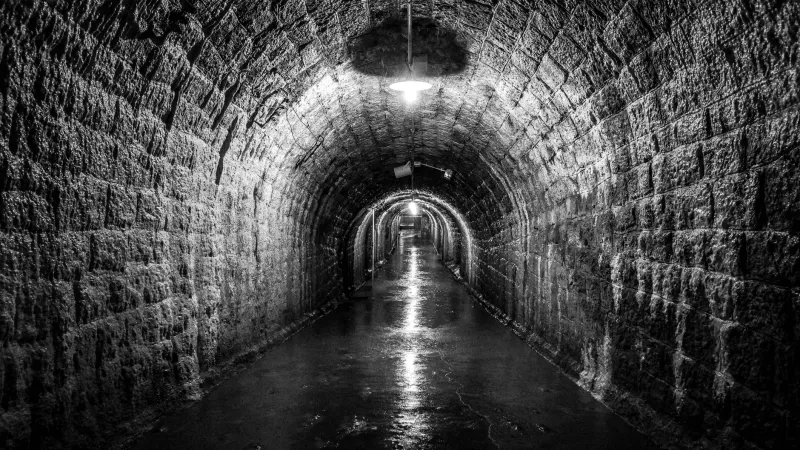
At some point during the construction of a serious post-apocalyptic narrative, the writer faces a choice that is also, whether they recognize it or not, a philosophical statement. The story can unfold in the open air, among the ruins and the weather and the dangerous freedom of a world without institutions. Or it can descend.
American fiction, with striking consistency, descends.
The underground has become the preferred theater of post-collapse imagination — not merely as a convenient setting but as a symbol system so loaded with psychological and cultural meaning that its recurrence demands examination. To understand why writers keep sending their characters below ground is to understand something essential about how Americans conceptualize safety, community, and the price of survival.
The Architecture of Controlled Fear
The appeal of subterranean spaces in fiction is not difficult to identify at a surface level. Bunkers and vaults create natural narrative compression. They limit the cast, constrain the geography, and force confrontation between characters who cannot simply walk away from one another. In purely technical terms, they are excellent dramatic engines.
But the best works in this tradition — Hugh Howey's Silo series, Cormac McCarthy's The Road (which treats its underground passages as temples of the lost world), and more recently the wave of thriller fiction that has followed the COVID-era surge in bunker sales — use the underground for purposes that exceed structural convenience.
These spaces encode a specific relationship between security and imprisonment. The bunker protects, but it also confines. The vault preserves life, but it does so by severing the inhabitant from every external reference point — sky, season, horizon, community. The fiction that takes these spaces seriously almost always arrives, eventually, at the same terrible question: at what point does the shelter become the catastrophe?
Vaults, Silos, and the American Instinct to Systematize Survival
There is something distinctly American about the bureaucratic bunker — the facility with intake procedures, resource allocation charts, and a governance structure that replicates, in miniature, the society it was built to outlast. The Fallout video game franchise, which has generated enormous novelistic and narrative influence even beyond its own medium, built an entire mythology around Vault-Tec's sealed underground communities, each one a controlled experiment in human behavior under conditions of permanent emergency.
This vision resonates because it dramatizes a genuine tension in American political culture: the conflict between collective organization and individual liberty. Inside the bunker, collective organization is not a political preference but a survival requirement. Resources must be rationed, roles must be assigned, dissent must be managed. The bunker strips away the luxury of ideological flexibility and forces its inhabitants to confront the authoritarian logic that underlies any sufficiently stressed community.
Howey's Silo sequence is perhaps the most sustained literary exploration of this dynamic currently available to American readers. Its underground communities have developed entire cosmologies to explain and justify their confinement, and the horror of the narrative lies not in any external threat but in the revelation that the systems governing the silo were designed not to protect their inhabitants but to study them. The shelter was always also a laboratory.
Subway Systems and the Archaeology of the Surface World
Distinct from the purpose-built bunker is a second category of underground setting: the repurposed infrastructure. Subway tunnels, storm drainage networks, abandoned utility corridors, and Cold War-era civil defense shelters appear throughout post-collapse fiction as spaces that were not designed for survival but have been adapted to it.
These environments carry a different emotional charge. Where the vault suggests planning and institutional intent, the repurposed tunnel suggests improvisation and the stubborn persistence of human ingenuity. Characters who inhabit these spaces are not the beneficiaries of someone else's foresight. They have descended into the infrastructure of the old world and learned to read it as a resource.
Dmitry Glukhovsky's Metro 2033 — a Russian novel with enormous influence on American genre fiction and game design — established the template most thoroughly: a civilization reconstructed in the Moscow subway system, complete with independent stations, trade economies, and political factions. The surface world, poisoned and inaccessible, exists as mythology. The tunnel is not a temporary refuge but a permanent homeland.
American adaptations of this template tend to locate their underground communities in more recognizable infrastructure — the New York City subway, the Chicago L system's maintenance network, the extensive tunnel complexes beneath Washington, D.C. that exist in both fact and considerable fictional elaboration. The familiarity of these settings grounds the fantasy in a specific cultural geography, asking the reader to imagine their own city's underside as a potential civilization.
What We Bury and Why
Psychologically, the bunker narrative enacts a fantasy that is also, examined closely, a confession. To build a shelter against the end of the world is to acknowledge that the end of the world is possible. The very act of preparation is an admission of vulnerability — and in American culture, where optimism and forward momentum are foundational values, that admission carries significant weight.
Fiction that explores underground survival spaces is, in this reading, a form of permitted catastrophizing. The reader can inhabit the worst-case scenario, examine its architecture and social dynamics, and emerge — as the character often cannot — back into the light. The bunker is a space where the culture's anxieties about climate, political instability, pandemic, and technological dependence can be given form and walked through without requiring actual commitment.
That the experience is frequently claustrophobic, frequently morally compromised, and frequently tragic is not a failure of the genre. It is the genre's primary service. These stories do not reassure. They examine.
Five Works That Navigate the Underground with Uncommon Precision
For readers prepared to descend, the following works represent the current high-water mark of subterranean post-collapse fiction:
Hugh Howey's Wool remains the essential starting point — a masterclass in using architectural confinement to generate both plot and philosophical inquiry.
Jeff VanderMeer's Annihilation treats its underground spaces as genuinely unknowable, resisting the genre's tendency to explain what lies beneath.
Emily St. John Mandel's Station Eleven, while primarily a surface narrative, uses its underground passages as repositories of memory and loss.
Colson Whitehead's Zone One engages the subterranean infrastructure of Manhattan as a palimpsest of the civilization that has ended.
Paul Tremblay's A Head Full of Ghosts is not strictly post-collapse fiction, but its use of a sealed domestic space as a psychological pressure chamber prefigures many of the underground narrative's most effective techniques.
Each of these works understands that the space below ground is not simply a setting. It is an argument — about what we value enough to preserve, what we are willing to sacrifice for security, and whether the civilization we carry underground with us is worth the cost of carrying it.